In antiquity, the Olympus massif forms the border between Thessaly and Macedon. The history of the surrounding area is consequently of interest in the context of the Rise of Macedon, the Chremonidean War and the Macedonian Wars during the 4th to 2nd centuries BC. In the period of the Ottoman Empire the mountain was a hiding place and base of operations for klephts and armatoloi.
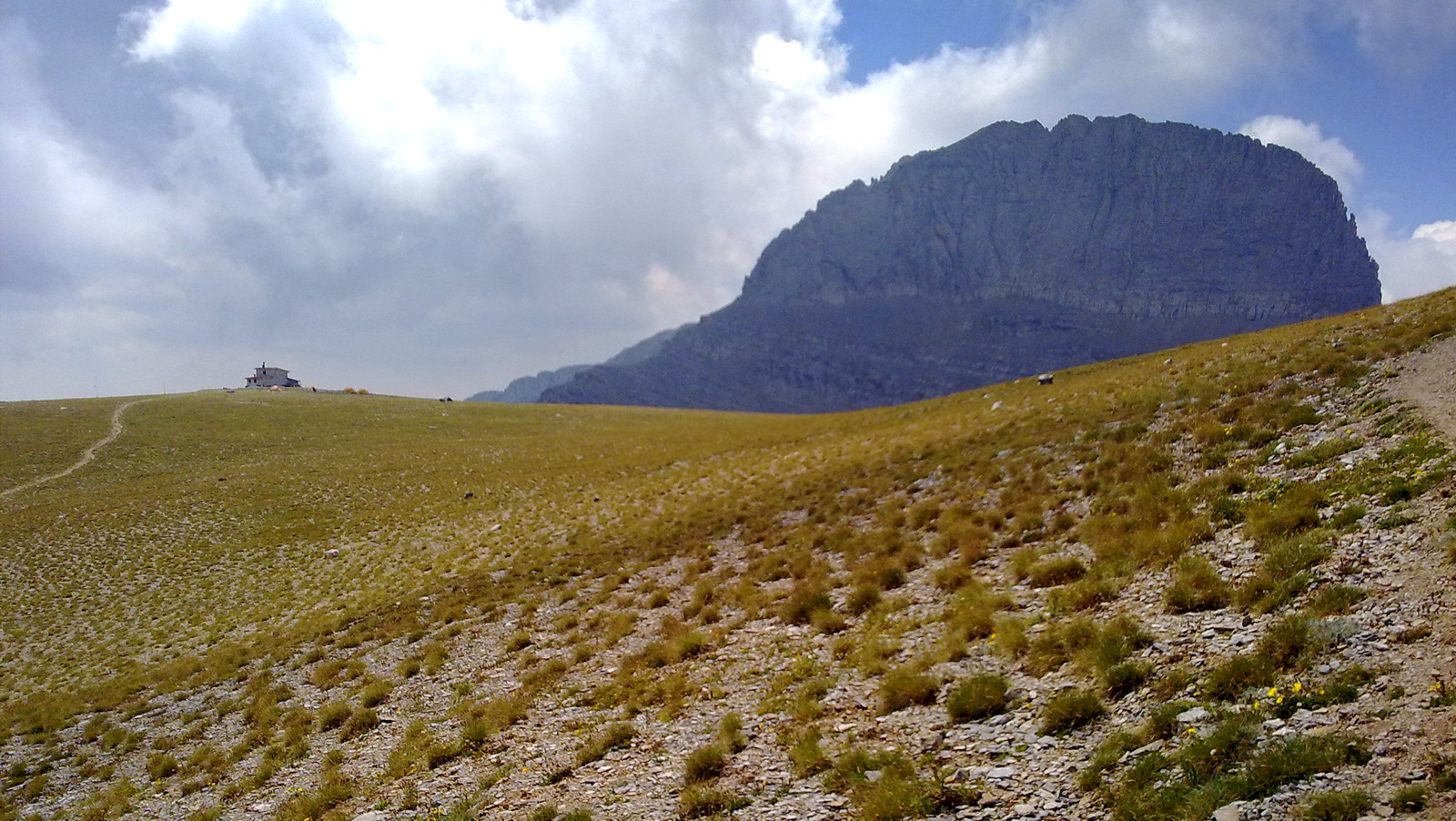
In Olympus, the second armatoliki was founded, led by Kara Michalis in 1489. The action of the klephts in Olympus led the Turks to visit their outrage on the klephts’ ally-village of Milia (in the late 17th century), which they destroyed. In that period Livadi in Olympus became the seat of the armatoliki of Olympus and Western Macedonia, with their first renowned commander Panos Zidros. In the 18th century the Turks had to replace the armatoloi (who very often joined the klephts) with Moslem Albanian armatoloi who ravaged the countryside of Macedonia. However, Olympus’ armatoloi, even after their capitulation to Ali Pasha, never ceased fighting on land and at sea. Among them who were active there and in nearby regions were Nikotsaras, Giorgakis Olympios and the legendary family of Lazaioi. In the early 20th century, even for some time after the liberation from the Ottoman Empire (1912), robbers were active in the region – the best known of them the notorious Giagoulas, while during the German invasion in 1941 the Greek army fought significant battles along with units of New Zealanders and Australians. During the German Occupation (1941–1944) the mountain was one of the centers of the Greek Resistance, while a little later the Greek Civil War (1946–49) started there, in Litochoro.
Ancient and medieval sites
Main article: History of Pieria (regional unit)
The whole region of Pieria’s Olympus was declared archaeological and historical site for the preservation of its monumental and historical character. Five km away from the sea is Dion, sacred city of the ancient Macedons, dedicated to Zeus and the Twelve Olympians. Its prosperity lasted from the 5th century BC to the 5th century AD. The excavations, continuing since 1928, have revealed numerous findings of the Macedonian, the Hellenistic and the Roman period. Currently there is a unique archaeological park of 200 hectares, with the ancient town and the sacred places of worship, outside its walls. Many statues and other invaluable items are kept in the nearby Dion’s archaeological museum.[14] Pimblia and Leivithra, two other towns in Olympus’ region, are related to Orpheus and the “Orphic” mysteries. According to a tradition Orpheus, son of Apollo and Calliope (one of the Muses), taught here the mystic ceremonies of worship of Dionysus (also known as Bacchus).By the sea, in a strategic position, at Macedonia’s gates is located Platamon Castle, built between 7th and 10th century AD in the ancient town of Heracleia. To the north the ancient Pydna is located. Here, in 168 BC, the decisive battle between the Macedonians and the Romans took place. Between Pydna and Mount Olympus are a fortified bishops seat from the Byzantine period called Louloudies and the Macedonian Tombs of Katerini and Korinos.
Christian monuments
Main article: Monasteries and churches at Mount Olympus
Monastery Kanalon
In the Olympus region, there are also several Christian monuments, among them the highest-altitude chapel of Orthodox Christianity, dedicated to Prophet Elias, in Greek tradition associated with mountaintops, on the summit of the same name (Προφήτης Ηλίας Profitis Ilias), at 2,803 m. It was built in the 16th century by Saint Dionysios of Olympus, who also founded the most significant monastery in the region. The Old Monastery of Dionysios (altitude 820 m) lies in Enipeas’ gorge and is accessible by car from Litochoro. It was looted and burned by the Ottomans and in 1943 it was destroyed by the German invaders, who suspected it was a guerrilla den. Nowadays it has been partially restored and operates as a dependency of the New Monastery of Dionysios, that is outside Litochoro.On Olympus’ southern foot, in a dominant position (820 m) in Ziliana gorge, there is the Kanalon Monastery, 8 km away from Karya. It was founded in 1055 by the monks Damianos and Joakim and since 2001 it has been restored and operates as a convent. Further west, in the edge of Mavratza stream, at 1,020 m, there is the Agia Triada Sparmou Monastery, that flourished in the early 18th century, possessed great property and assisted to establish the famous Tsaritsani‘ school. It was abandoned in 1932, but in 2000 it was completely renovated and reopened as a male monastery, affiliated to Elassona‘s diocese.[18]
Climbing expeditions
The third highest peak of Mt Olympus, called Agios Antonios (Άγιος Αντώνιος “Saint Anthony”, 40.0677°N 22.3511°E, 2,817 m), is known to have been the site of a sanctuary of Zeus in antiquity based on archaeological finds discovered in 1961. In the modern era, a series of explorers tried to study the mountain and to tried to reach its summit. Examples include the French archaeologist Leon Heuzey (1855), the German explorer Heinrich Barth (1862), and the German engineer Edward Richter. Richter tried to reach the summit in 1911 but was abducted by klephts, who also killed the Ottoman gendarmes that accompanied him.
It was just one year after the liberation of northern Greece from Ottoman rule, on 2 August 1913, that the summit of Olympus was finally reached. The Swiss Frédéric Boissonnas and Daniel Baud-Bovy, aided by a hunter of wild goats from Litochoro, Christos Kakkalos, were the first to reach Greece’s highest peak. Kakkalos, who had much experience climbing Olympus, was the first of the three to climb Mytikas. Afterwards, and till his death in 1976, he was the official guide on Olympus. In 1921, he and Marcel Kurz reached the second highest summit of Olympus, Stefani. Based on these explorations, Kurz in 1923 edited Le Mont Olympe, a book that includes the first detailed map of the summits. In 1928, the painter Vasilis Ithakisios climbed Olympus together with Kakalos, reaching a cave that he named Shelter of the Muses, and he spent many summers painting views of the mountain. Olympus was later photographed and mapped in detail by others, and a series of successful climbs and winter ascents of the steepest summits in difficult weather conditions took place.
Climbing Mount Olympus is a non-technical hike, except for the final section from the Skala summit to the Mytikas peak, which is a YDS class 3 rock scramble. It is estimated that 10,000 people climb Mount Olympus each year, most of them reaching only the Skolio summit. Most climbs of Mount Olympus start from the town of Litochoro, which took the name City of Gods because of its location at the foot of the mountain. From there a road goes to Prionia, where the hike begins at the bottom of the mountain.
 Olympus - The mountain of Gods